My full name is Oluwadamilare Oyefeso. However, I go by Joka. Pronounced (joe-kay). People always seem to ask why I prefer to be called Joka and that is because it is my middle name. All my life this is the name I have gone by. Even at home this is the name my family calls me. My first name means “God has vindicated me.” Joka ultimately means for people to come together to love, care and pamper me. I am a first-generation Nigerian student. My parents are both from Nigeria but from different cities. My mom is from Owo, Nigeria while my dad is from Lagos, Nigeria. These cities are probably about 2 hours away from each other if one were to drive from one to the other. My parents met in Brooklyn through a mutual friend. When my mom first came to this country when she was 24 years old, she was staying with a friend whom my father also had already known. I always found it amusing that my parents lived in the same country for over 20 years but then met in a different country. About 15 years later, I was born. Just 7 years before my older brother and sister and 11 years before my two eldest sisters. I am the youngest of 5 children. I met my two older sisters when I was 10 and she was 15, then the other when I was 15 and she was 26. Out of 5 of us kids only 3 of us know our country’s native language which is Yoruba. Unfortunately, I am not one of those 3. My older brother and I are the only ones in the house who don’t understand or speak Yoruba. However, my brother is in the process of learning and is real determined to become fluent. He does this through listening to Nigerian music and ultimately making his own. It often just comes out as broken English, but he is making immense progress. He gets some help from my grandmother who also lives with us. She’s 86 years old and she just moved to America in 2015. So, you could imagine the difficulty with us understanding her. Although English is Nigeria’s first language, at times it is still hard for my grandmother to understand what I am saying.
Scrapbook Links
- 10 Primary Sources
- Zulu Reflection
- Wretched of the Earth ch. 1 & 2
- Wretched of the Earth ch. 3 & 4
- Wretched of the Earth ch. 5-Conclusion
- Analysis of Primary Source: Oliver Stanley Speech
- Analysis of Primary Source: Patrice Lumumba’s Speech & Letter to his Wife Pauline
- Response to Dambisa Moyo’s Video Presentation
- 1000 Word Machete Season Reflection
- Primary Source worksheet: Jules Ferry (On French Colonial Expansion)
- Primary Source Worksheet: Joseph Chamberlain (Speech at Walsall)
- Blog Post 1: How Europe Underdeveloped Africa Chapters III, IV & V
- Blog Post 1: How Europe Underdeveloped Africa Chapter VI
- Group Discussion Notes on How Europe Underdeveloped Africa (02/12)
- Group Discussion Notes on How Europe Underdeveloped Africa (02/26)
- 500 Word Final Scrapbook Reflection
10 Primary Sources
1. The article “The Colonization of Africa” by Ehiedu E. G. Iweriebor talks about the holistic process and literal scheme to colonize Africa. The scheme to colonize Africa was to control the continent economically, socially and politically. This way Africa would not be able to do anything under their own control if it didn’t first go through the European colonizers. Seven countries were involved in this scheme; Britain, France, Germany, Belgium, Italy, Portugal, and Spain were all in competition to have the superior power over European power politics. This is where the phrase “the scramble for Africa” came about. The competition became so profound that people were afraid of conflict and eventually a war between the colonizing countries. As a result of this fear came the infamous Berlin Conference that was held from November 1884 to February 1885. This conference constructed a treaty that is known as the Berlin Act.
2. In the article “The Partition of Africa” by Courtney Faal, Faal sort of furthers Iweriebor’s explanation of what happened during and after the Berlin Conference. Faal explains to us that overall goal of this conference was to go over and confirm that all the countries were basically on the same page. Each European country that owned a section of Africa had to enforce their religion, which was Christianity, as well as trade to each area of Africa that they claimed. By the time the year 1914 came around, most of Africa was split between Britain, France, Germany, Belgium, Italy, Portugal, and Spain. The only countries that had yet to be conquered was Liberia and Ethiopia.
3. In the article “African Colonial States” by Heather J. Sharkey, Sharkey talks about late colonialism. She starts by explaining that when one brings up late colonialism, they are referring to anywhere between the time of the 1930s to the 1960s, or a time before independence was officially granted. During this time, government officials had several political, social, economic and even global issues being thrown at them. This caused there to be a lack of belief in the success of the colonial business. Today, there are historians in Africa that are extremely focusing on the era of post colonialism. They are searching for answers that only dissections of events in this time can explain and ultimately answer. the question that is mostly trying to be answered is ‘how much of the late colonial era effected Africa in the early 1900s.
4. In Steve Metz article “American Attitudes Towards Decolonization in Africa” Metz begins by telling us there are pretty much two separate takes that America has on the decolonization of Africa. The first perception is that if America never interfered and suggested United States laws on decolonization and advocating for “self-determination” while John F. Kennedy was in office, the European colonizers would have kept their ruling over the continent of Africa going for way longer than it did. The other perception was that the suggestion of United States laws on the decolonization in Africa only really initiated the transition of the original possession that these European countries had over Africa to the convert control of corporate America. These two opposite perceptions leave the question of what the United States actual role was in the decolonization of Africa. This article fits into our course because it correlates to the struggles and paths Africa had to take in order to achieve change and political independence.
5. This source fits into the segment of the course because it ultimately elaborates how Africa’s underdevelopment is a legacy of European Colonial Rule. Stelios Michalopoulos and Elias Papaioannou are co-authors of the article “The Long-Run Effects of the Scramble for Africa”. In the article they explain to us that the result of European colonialization in Africa does not go unnoticed and is still affecting Africa today. One way that is brought up is what Stelios and Elias called “improper border design”. Improper border design was the process of European colonizers splitting up areas of Africa the wrong way. Many regions in Africa that already had its set boundary were basically split up. Because of this, many African tribes today are improperly placed. This means that certain people of specific tribes portray to be a part of one tribe but are really associated with another. As one of the results of this is ethnic wars and discrimination of ethnicities that are constructed of more than one.
6. In the poem, “The Cathedral” by author Kofi Awoonor, she uses several metaphors to vividly illustrate what went on within European colonialism in Africa. She paints the image of a big beautiful tree standing tall with its roots firmly in the ground, branches standing high with confidence and leaves glowing from the shine of the sun so vibrantly. The tree is effortlessly stunning oh and its even minding its own business. Awooner goes on to describe the tree being cut down by “surveyors and builders” and these people casually building a “cathedral of doom” over the tree’s former sport. I loved the metaphors that were used here because it gives a perfect explanation of the way European colonizers nonchalantly takeover Africa and changed African civilization forever. This image being painted is a metaphor for the Europeans forcing their religion on the people of Africa throughout the colonization period. The Cathedral of doom is representation of Christianity. When Africa was being colonized, they were stripped of anything and everything that they planted from the ground up. This poem fits into the segment of the course because it perpetuates the way Europeans bullied their way into Africa, knocked their empire down and built their own civilization, with no permission or no full comprehension. They just did what they wanted.
7. This poem is called “The Lord’s Prayer” by Sonna Armon. Similar to the poem “The Cathedral”, Armon talks about the church. However, in this poem not only does she use metaphors to help us visualize, but she does it in the form of a prayer. The poem tells us that when Africa was colonized, although the Europeans made it seem that this imperialism was harmless and actually helping the people of Africa and did so by using religion as a gateway, it was not so elegant and graceful as they portray. Even if the colonizers really did think they were selflessly and delicately trying to help the people of Africa, it felt like hell to the ones being exploited. When they first approached the continent, they came with huge scary weapons, which is clearly not graceful. They came with books that the African people could not read. They came with a new religion with a spiritual being that looked like them. They told them false things such as ‘God loves everyone, but He loves you less’. They told them that their original way of life was evil and monstrous. They deprived them of their language, their names, their way of life and in return they gave them their God. This poem is correlated to the course because it portrays the exploitation rather than development of colonialism in Africa.
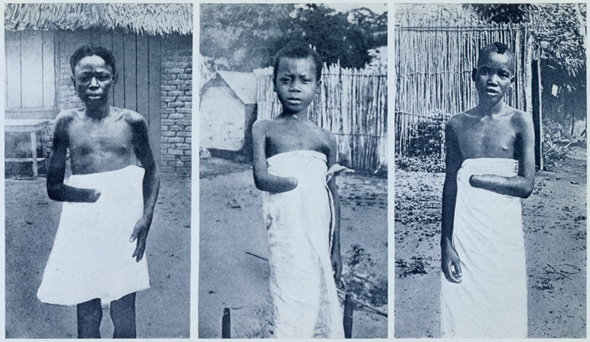
8. This photograph above was taken in 1905. This is an image of three Congolese young boys with one hand each. Their hands were cut off because they did not reach the number of rubber collections that was given to them. Consequences of not reaching the quotas resulted in King Leopold II, colonizer of the Congo region of Central Africa at this time, dealing with them. The way he cruelly punished these innocent people was by torturing them with a slow and painful death. He would cut off ligaments, limbs, genitals and several other body parts. He would do this to men, women and even children. He ruled the Congo for 23 years and killed millions of Congo people within that time span. This photograph is relevant to the course because it vividly conveys the cruel things that would happen while Africa was being imperialized.
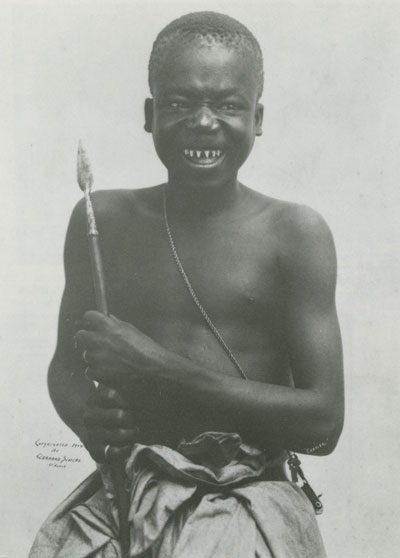
9. This image above evidently shows the exploitation done to the Congo people by the Belgium’s. This is a photograph of a young Congolese boy in a cage at a zoo. The reason for him being in the cage is because the colonizers wanted to convey the animalistic perception they had of them and that they associated with African people. This young boy was being exhibited like this right alongside of chimpanzees and apes. This was done to show the missing stage of humanity and also the correlation between orangutans and human beings. This is relevant to the course because the image perpetuates the humiliation, exploitation and regular treatment done by colonizers to the African people. This is not only an example of the degrading things that were done to African people, but it shouts the epitome of racism at you.
10. Neocolonialism in Africa is tricky I might say. I personally feel as if because Africa was once exploited, there’s a possibility that they can be exploited again if they’re not careful. It has nothing to do with superiority vs. inferiority, but it’s more about the question of whether or not Africa is ready or prepared to seriously discuss and go forward with globalization and the new scramble for Africa. It doesn’t really seem like Africa has a set plan in order to take back their power and to just being involved globally. I mean what is it that they want and what strategy do they have in order to get what they want for their continent. I just think it’s really important that Africa watches who they make their deals with. In this video “A Second Scramble for Africa?” the Speaker, Amaka Anku explains to us that in the new scramble for Africa, Africans eventually can win. Reasons for this is because the continent is in a better situation to negotiate their own trade and economic policies. In the present time, Africa definitely has gained some sort of new political maturity and has a good vision for the future, but the question is, when are they going to take action? With this new hopeful vision that the youth of Africa have gained, they need to become more educated in the governmental system. And not just the people in power, but the civilians as well. When the politics of Africa get a lot more competitive, voters will eventually have more say and will be able to insist on a form of neoliberalism that can work for both Africans and foreigners. This video fits into the segment of the course because of the neocolonialism in Africa, this new era and the scramble for Africa gives the continent a greater opportunity.
Final Scrapbook Reflection
Throughout this course I have learned so many new things. Initially, when we started this course, I was very intrigued but at the same time I found lots of things confusing and just overall hard to follow. There are so many things that falls into the underdevelopment of Africa because the process went on for so many years. 2020 is the 400-year mark of African slaves in the United states. By the 1800s we can look back and see the steps that were being taken to start the end of slavery. Although one of the several colonizing countries, infamously known as, Britain abolished slavery in 1807, it wasn’t up until about the 1840s that their gesture of convincing other European powers to give up slavery as well was successful. Something that really hit me was although slavery in certain nations were abolished, some places had this inhumane phenomenon of owning people still going. I mean, once it was globally evident how disturbing and cruel it was to treat people as property, also being that there was the comprehension that you can use machines instead of people, you would think the rest of these cruel nations would abolish slavery shortly after others did, right? WRONG! Slavery in West Africa didn’t stop until the 1930s just because it was still profitable for them. One thing that was intriguing to me was seeing the perception of the colonizers during this time. This was done in the novel “Wretched of the Earth” by Frantz Fannon.
This was my favorite novel that we read this semester. Something that Fannon said that has seemed to really stick with me ever since, was in the opening of the book. Before anything else he makes sure that readers understand that no matter what colonizers might try and deem colonization as; Whether they say they had noble intentions or wanted to help the place they were colonizing, never forget that colonization is always a violent process. Don’t let them off the hook when they are the ones who started the mess. I mean, what actual noble GROUP of people uses human beings as property and equates them to modern day cars that you can use and sell at an auction? Fannon imbedded in me that there’s no other way to go about it other than to use some sort of force. Whether the force is used physically, mentally, spiritually or all three, it was still in a very evidently savage way. Without him saying the words exactly I feel as if he was telling his readers not to let them pull one over on you. It was kind of like he was saying ‘let’s get something straight here…’ it felt so personal. It felt as if he was talking directly to me and wanted me to change my ways of thinking. Overall, I loved the approach he took with it. And honestly, whether or not their intentions were in the right place the phenomenon still doesn’t go unnoticed, there are still generations being affected by it all. There are still communities of people that have an unshakeable stigma attached to them all because of the selfishness of the colonizer, and that’s something they can’t take back.
Lastly, it was very liberating learning that there is still hope and opportunity for Africa and its people in today’s global society. It’s just something that they really have to work for as a unit. I truly believe that if corporate America wasn’t so overtly rooted in the racism against Native Africans and African Americans, this country could help Africa stand back up on their own. But realistically speaking, that’s not going to happen anytime soon. So, until then I will continue to root for my mother land.
Group Discussion Notes on How Europe Underdeveloped Africa (02/26)
Education is important. it can promote social change. p.315
-In colonial Africa, the Europeans realized that some education would maximize the value of labor.
-Performance can be enhanced by the European education.
-This education only truly helped the Europeans. It was never beneficial to Africans. The education implemented to the Africans was an education that was only high enough to do the jobs that the Europeans wanted them to know. Therefore, Africans would never be able to move on their own.
Group Discussion Notes on How Europe Underdeveloped Africa (02/12)
Why did the servants of the Dutch West India Company try to force people on the Ivory Coast to buy certain amount of Dutch goods?
-they wanted to put a complete stop to the African trade but it didn’t work. Dutch ruled that each Axim Canoe-man going to Cape Lahou should carry Dutch goods worth at least four ounces of gold. Because it would eventually convert a purely inter-African exchange into a European-African trade.
When Europeans became middle men in local trade networks, they did so mainly to make it easier to extract captives, which lessened their importance to the European Slave Trade.
“There is a type of false integration which camouflage for dependence”
-This was disguised as free trade in the formally colonized sections of the world.
15th century onward false integration acted as interlocking African economics over long distances. although they thought the interlock of African economies were happening, they were actually secretly passing human captives and ivory.
Blog Post 1: How Europe Underdeveloped Africa Chapter VI
Colonialism: Present in the school system, the economic system, it played a role in underdevelopment of the continent of Africa,
“Capitalists under colonialism did not pay enough for an African to maintain himself and family. (265)”
In this paragraph, we see how Africans were exploited for their work. They were essentially being paid nothing for their labor. Whatever little shillings that were gained, went to taxes, etc. He makes a note that a very select few had to pay for school, which were missionary schools. This shows how whatever money was made, if any, went back to the colonists and colonial economy. Of course, playing a significant role in the underdevelopment of Africa.
“First three decades of colonialism, hardly did anything that was done that could remotely be termed a service to the African people… after all, the statistics which show that Africa today is underdeveloped are the statistics representing the state of affairs at the end of colonialism.” (246) this paragraph is important to refute the lie that colonialism helped develop Africa, when it did the opposite. The African population did not thrive from capitalism like the Europeans did. Any amenities otherwise acquired by colonies isn’t a guide for what African people got out of colonialism.
“But, in Africa, colonialism did not bring those benefits-it merely intensified the rate of exploitation of African labor and continued to export the surplus.” (312)
This paragraph is important because we can see how Africa was trying to get back their individualism from Europe. However individualism didn’t work out too well for African countries, it did more harm than good and exploited the laborers in Africa. As we can see, this has become a problem politically, economically and socially for African people. Economically the laborers were being exploited and were getting paid little because of the jobs that they held. Socially individualism caused it to be more of a separation between the people especially in the school system because colonialism programmed it in a way that there was no social responsibility from the people. Politically it caused it to be a problem because the process was delayed because Africa was trying to gain back their individuality to have full control over what was once theirs.
“Early educational commissions also accorded high priority to religious and moral flavoring of instruction – something that was disappearing in Europe itself. The role of the Christian Church in the educational processes obviously needs special attention. The Christian Missionaries were as much part of the colonizing forces as were the explorers, traders, and soldiers.” (Pg. 308)
During the period of European rule in Africa, an aspect of colonization that is often overlooked deals with education and religion across the continent. With Christian missionaries making their way into the African nations, the one thing that became clear was their motives to spread the Christian faith amongst African communities through implementing Christian and European standards upon the African population. This was a piece in the overall capitalistic system that was being forced onto the African people by pushing Christian and European values in the educational system.
“In colonial Africa, the European bourgeoisie realized that some education would maximize the value of labour.” (315)
The text says it was not necessary to educate the African masses because only a small part of Africa actually entered the colonial economy in a way that their performance could be enhanced by education. However, in colonial Africa, when the Europeans realized that some education would increase the value of labor they went right for it. This education only really helped the Europeans. The intention of this education was never to benefit the African people for themselves, but to enhance their performances on the work the Europeans needed them to do. The education implemented to the Africans was an education that was only high enough to do the jobs that the Europeans wanted them to do, and high enough for them to never be able to advance on their own. The Europeans did a successful job on preventing Africans from advancing without their help.
Blog Post 1: How Europe Underdeveloped Africa Chapters III, IV, V
Group Name: The 4 Nubians and the Pharaoh
All the quotes we found to be the most important in these two chapters emphasized the main point that European colonization was only beneficial to European countries. Our quotes introduces the injustices that was imposed on the African societies; in this process, this depleted Africa economically, socially, technologically, and politically.
While European Countries were exploiting Africa and building their economies, Africa was being depleted and wasn’t advancing technologically. Raw materials are being extracted from Africa then taken to these European countries where they are being manufactured. After this process, they are then sent back to Africa to be sold at a higher price. Rodney states a direct correlation between the two on page 118 ,“This remarkable reversal is tied to technological advance in Europe and to stagnation of technology in Africa owing to the very trade with Europe”. Furthermore, they also didn’t allow for factories to manufacture products that were commonly used. This prevented a working class to form. Essentially, Europe didn’t create an environment where capitalism could thrive. This is seen through the fact that Africa was not divided by socioeconomic status nor was there complaints of inequalities based on class.
Economically, Africa was at an advantage when it came to their banking system. As for Europe they had other plans for Africa as a whole, Europeans colonizers came into Africa stole their banking system idea and took it back to Britain to build up a better technologically based economic system . On page 195 it states “Finally, Africa Provides an interesting example of how effectively foreign banks served to dispossess Africa of its wealth. Most of the banking and other financial services were rendered to white settlers whose conception of “home” was always Britain.” When European colonizers got a hold of that system automatically we can see how taking away the foreign banking system left them to fend for themselves cause if the African countries to remain at the bottom of the social hierarchy system. The white man’s goal was to keep the relationship between them and Africa one sides so that they can maintain their superior “duty”.
Throughout this process, African societies were taken advantage of right under their noses. The Dutch West India Company wanted to put an immediate stop to the African trade. What seemed like integration, really was the free-trade areas in sections of the world that were colonized prior. No this did not cause complete destruction of the West African gold trade; However, it cause Africa to become dependent on European buyers. These continuous unfair events eventually led to Africa’s underdevelopment.
-A deprived of their ability to thrive because of European resources resources Can’t thrive due to resources
-Creates this dependency theory
Structural problems europeans created, Official positions, no factories, slave trade, change their education system , extraction of natural resources, free labor, exclude them from law making, division of groups, divide and conquer
Making the argument of Africa’s underdeveloped crisis is due to structural…..
Primary Source Worksheet: Joseph Chamberlain (Speech at Walsall)
Question 1: what are some of the chamberlain’s underlying assumptions and arguments?
- He’s arguing the advocacy for extending the empire to combat the underdevelopment of the empire and also unemployment that still exist. The assumptions that were made by Chamberlain was that Britain was entitled to owning a vast majority of territory around the world.
Question 2: How does chamberlain perceive the british empire?
- Chamberlain sees it as an empire that can grow into something larger and more beneficial to the people that are a part of this empire. In the quote Chamberlain compares Britain to a landlord owning an estate, to perceive as business like people having the right to use the land in the way that would benefit them.
Question 3: Is chamberlain motivated by any ideologies? What are these”
- Yes Chamberlain was motivated by different ideologies such as money, power and business revenues, with that he would be able to navigate a territory the way that he pleased.
Jules Ferry (1832-1893) On French Colonial Expansion
JUlES FERRY (1832-1893) On French Colonial Expansion Joka Oyefeso, Michael Anderson (Scribe), Martha Alvarez, Alliyah Dookie, Melannie Atkinsin.
- How will colonial expansion really benefit France?
- It will give France, a nation that believes they’re superior, more economic, social and political prestige on the world stage.
- Economics – They would have more markets and boost their industry. It creates more outlets and creates an interdependent system that only benefits France.
- Socially – Bragging rights and power for the upper class.
- Political – Expansion of the French military/navy along with cultural influence around the world that can rival other European Powers.
2. What historical references does Jules Ferry use to justify France’s Colonial expansion.
- Jules Ferry uses the example of failure among European powers during the exploration of the New World by European powers such as Spain, Britain and Portugal.
- He continues with these examples to point out their failure to “civilize” the native peoples which eventually led to their downfall in the new world through rebellion.
- He uses these as references to support his argument to expand French Colonialism because he believes that France can improve on their failures and show them how to properly colonize and “civilize” foreign lands.
- In all reality colonialism to Jules Ferry was never about “civilizing”, rather it was about expanding French dominance across the world and securing more wealth and power for the French people through exploitation of other people and their land.
Machete Season Reflection
The novel Machete Season: The Killers in Rwanda is a book in which Jean Hatzfield dives deep in to the minds of the Hutu, the men that are to blame for the massacre of the Tutsi people. Before reading this novel, I didn’t really know much about the Hutu or the Tutsi. Of course we all know there were killings and murders involved, however I never fully grasped the reason for it all. So, for one to have an actual sit down discussion to deeper understand what was going on in their minds is really interesting. You would think that these literal serial killers wouldn’t be so open to talking about what most would call immoral and evil actions, however somehow Hatzfield managed to get the truth out of these men about the crime-filled genocide they committed. This novel heavily reminds me of Wretched of the Earth, and how Frantz Fannon got to dive into the outcome and trauma of the African people that were colonized. However, one thing I would’ve loved to also see was a sit down with the colonizers themselves, to get a more in depth understanding of what was going through their heads throughout all of those years.
Oppose to Fannon’s Wretched of the Earth, something I got from the novel Machete Season was a bit of that psychopath mindset that I was longing for. I just think it’s really intriguing to understand how a mass murderer thinks. I mean we all know how we’d feel if we were in the middle of being colonized or even if we were to witness genocide. Most of us would be scared out of our minds even though we’ve never been through it. However, normally a regular person does not know what it is like to be a mass murderer like the Hutu, it’s close to impossible to imagine what emotions and feelings they were going through while assassinating people left and right. But don’t you worry, later on we find out exactly how they felt.
I think it was very clever but also gruesome to make the title “Machete Season”. I feel as if it’s equivalent to saying ‘the time where the Tutsis were filled with bullets”. Cruel, but basically truthful. However, instead of a gun filled with bullets it was a knife that was being thrown around to slice bodies and limbs in half. The reason it was given this title is because the machete was the most popular weapon used throughout this genocide.
It all started in April of 1994, where the Hutu were creating genocide against the Tutsis. Hundreds of thousands of Tutsis were being slain, thousands by day. Every day these monstrous Hutu men would wake up and do normal human being things, they’d brush their teeth, wash up, and eat. Then like the psychopaths they are, they would get out there on the field to kill. It was like a daily ritual. The Hutu had to kill a specific amount of Tutsi people by the end of each day. They did what they were told everyday with no disappointment. One thing you could count on them to not do is disobey their orders. They would get in position on the field so when it was time, they’d be ready to aim and fire at their opponents. Although this seemed like such a set plan, it was more of them just getting out there and killing as many Tutsis they’d came encounter with.
In the novel, Jean Hatzfield tells about his interview he had with a number of the Hutu killers. We find out that they are all friends and were mostly famers who each participated in murdering thousands of their Tutsi neighbors. You know how sometimes when you watch a film and the bad guy is getting away, you almost don’t want him to get caught because you build some sort of attachment to the character. I thought that would happen in this novel. I thought I’d eventually have some sort of sympathy for the Hutus, but the more pages I read, the more hatred I built up for them. Further in the book these evil men explain how when they killed, it was something that basically liberated them and made them feel really good. Fulgence, one of the Hutu, furthers my claim and says “The more we cut, the more cutting became child’s play to us, for a few, it turned into a treat, if I may say so.” It seems that these men found joy in killing these people. Not to mention that they were not only killing men but women and children too. By this statement it is clear they had no remorse for their actions. It was then I realized and began to call these men psychopaths instead of just simply monsters. I mean come on, we are all human. What kind of human being doesn’t even feel remorse for taking an innocent child’s life? That’s right, a psychopath. Although some of these men might’ve felt a sense of guilt, it’s not like they stopped what they were doing and walked away from it. Nope they kept on obeying the cruel and evil orders they were given.
Like any other human being with a beating heart would, the only people I felt really sad for in this novel were the Tutsis, and maybe even Hatzfield for having to sit and listen to the seemingly arrogant, remorseless and cruel words of these men. Overall, as I previously stated, I did find this novel intriguing, however I did not finish reading the novel with a sense of relief like I did for Wretched of the Earth. At least in that novel there was a good outcome of more awareness of mental health. Oppose to Jean Hatzfield’s Machete Season: The Killers in Rwanda. But I guess I can say one satisfying reason that I can close this book with a smile on my face is knowing that the world is now aware that these psychotic monsters are not sorry about what they did and whatever the universe gives them, they completely deserve. Just like decolonization, genocide can never go unnoticed.

