1. The article “The Colonization of Africa” by Ehiedu E. G. Iweriebor talks about the holistic process and literal scheme to colonize Africa. The scheme to colonize Africa was to control the continent economically, socially and politically. This way Africa would not be able to do anything under their own control if it didn’t first go through the European colonizers. Seven countries were involved in this scheme; Britain, France, Germany, Belgium, Italy, Portugal, and Spain were all in competition to have the superior power over European power politics. This is where the phrase “the scramble for Africa” came about. The competition became so profound that people were afraid of conflict and eventually a war between the colonizing countries. As a result of this fear came the infamous Berlin Conference that was held from November 1884 to February 1885. This conference constructed a treaty that is known as the Berlin Act.
2. In the article “The Partition of Africa” by Courtney Faal, Faal sort of furthers Iweriebor’s explanation of what happened during and after the Berlin Conference. Faal explains to us that overall goal of this conference was to go over and confirm that all the countries were basically on the same page. Each European country that owned a section of Africa had to enforce their religion, which was Christianity, as well as trade to each area of Africa that they claimed. By the time the year 1914 came around, most of Africa was split between Britain, France, Germany, Belgium, Italy, Portugal, and Spain. The only countries that had yet to be conquered was Liberia and Ethiopia.
3. In the article “African Colonial States” by Heather J. Sharkey, Sharkey talks about late colonialism. She starts by explaining that when one brings up late colonialism, they are referring to anywhere between the time of the 1930s to the 1960s, or a time before independence was officially granted. During this time, government officials had several political, social, economic and even global issues being thrown at them. This caused there to be a lack of belief in the success of the colonial business. Today, there are historians in Africa that are extremely focusing on the era of post colonialism. They are searching for answers that only dissections of events in this time can explain and ultimately answer. the question that is mostly trying to be answered is ‘how much of the late colonial era effected Africa in the early 1900s.
4. In Steve Metz article “American Attitudes Towards Decolonization in Africa” Metz begins by telling us there are pretty much two separate takes that America has on the decolonization of Africa. The first perception is that if America never interfered and suggested United States laws on decolonization and advocating for “self-determination” while John F. Kennedy was in office, the European colonizers would have kept their ruling over the continent of Africa going for way longer than it did. The other perception was that the suggestion of United States laws on the decolonization in Africa only really initiated the transition of the original possession that these European countries had over Africa to the convert control of corporate America. These two opposite perceptions leave the question of what the United States actual role was in the decolonization of Africa. This article fits into our course because it correlates to the struggles and paths Africa had to take in order to achieve change and political independence.
5. This source fits into the segment of the course because it ultimately elaborates how Africa’s underdevelopment is a legacy of European Colonial Rule. Stelios Michalopoulos and Elias Papaioannou are co-authors of the article “The Long-Run Effects of the Scramble for Africa”. In the article they explain to us that the result of European colonialization in Africa does not go unnoticed and is still affecting Africa today. One way that is brought up is what Stelios and Elias called “improper border design”. Improper border design was the process of European colonizers splitting up areas of Africa the wrong way. Many regions in Africa that already had its set boundary were basically split up. Because of this, many African tribes today are improperly placed. This means that certain people of specific tribes portray to be a part of one tribe but are really associated with another. As one of the results of this is ethnic wars and discrimination of ethnicities that are constructed of more than one.
6. In the poem, “The Cathedral” by author Kofi Awoonor, she uses several metaphors to vividly illustrate what went on within European colonialism in Africa. She paints the image of a big beautiful tree standing tall with its roots firmly in the ground, branches standing high with confidence and leaves glowing from the shine of the sun so vibrantly. The tree is effortlessly stunning oh and its even minding its own business. Awooner goes on to describe the tree being cut down by “surveyors and builders” and these people casually building a “cathedral of doom” over the tree’s former sport. I loved the metaphors that were used here because it gives a perfect explanation of the way European colonizers nonchalantly takeover Africa and changed African civilization forever. This image being painted is a metaphor for the Europeans forcing their religion on the people of Africa throughout the colonization period. The Cathedral of doom is representation of Christianity. When Africa was being colonized, they were stripped of anything and everything that they planted from the ground up. This poem fits into the segment of the course because it perpetuates the way Europeans bullied their way into Africa, knocked their empire down and built their own civilization, with no permission or no full comprehension. They just did what they wanted.
7. This poem is called “The Lord’s Prayer” by Sonna Armon. Similar to the poem “The Cathedral”, Armon talks about the church. However, in this poem not only does she use metaphors to help us visualize, but she does it in the form of a prayer. The poem tells us that when Africa was colonized, although the Europeans made it seem that this imperialism was harmless and actually helping the people of Africa and did so by using religion as a gateway, it was not so elegant and graceful as they portray. Even if the colonizers really did think they were selflessly and delicately trying to help the people of Africa, it felt like hell to the ones being exploited. When they first approached the continent, they came with huge scary weapons, which is clearly not graceful. They came with books that the African people could not read. They came with a new religion with a spiritual being that looked like them. They told them false things such as ‘God loves everyone, but He loves you less’. They told them that their original way of life was evil and monstrous. They deprived them of their language, their names, their way of life and in return they gave them their God. This poem is correlated to the course because it portrays the exploitation rather than development of colonialism in Africa.
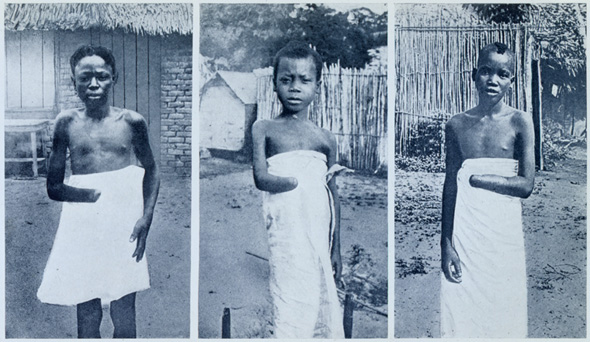
8. This photograph above was taken in 1905. This is an image of three Congolese young boys with one hand each. Their hands were cut off because they did not reach the number of rubber collections that was given to them. Consequences of not reaching the quotas resulted in King Leopold II, colonizer of the Congo region of Central Africa at this time, dealing with them. The way he cruelly punished these innocent people was by torturing them with a slow and painful death. He would cut off ligaments, limbs, genitals and several other body parts. He would do this to men, women and even children. He ruled the Congo for 23 years and killed millions of Congo people within that time span. This photograph is relevant to the course because it vividly conveys the cruel things that would happen while Africa was being imperialized.
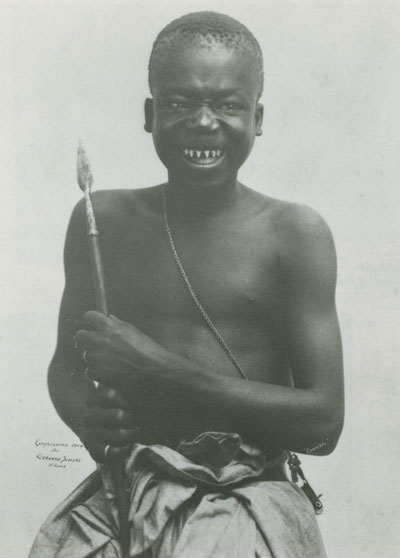
9. This image above evidently shows the exploitation done to the Congo people by the Belgium’s. This is a photograph of a young Congolese boy in a cage at a zoo. The reason for him being in the cage is because the colonizers wanted to convey the animalistic perception they had of them and that they associated with African people. This young boy was being exhibited like this right alongside of chimpanzees and apes. This was done to show the missing stage of humanity and also the correlation between orangutans and human beings. This is relevant to the course because the image perpetuates the humiliation, exploitation and regular treatment done by colonizers to the African people. This is not only an example of the degrading things that were done to African people, but it shouts the epitome of racism at you.
10. Neocolonialism in Africa is tricky I might say. I personally feel as if because Africa was once exploited, there’s a possibility that they can be exploited again if they’re not careful. It has nothing to do with superiority vs. inferiority, but it’s more about the question of whether or not Africa is ready or prepared to seriously discuss and go forward with globalization and the new scramble for Africa. It doesn’t really seem like Africa has a set plan in order to take back their power and to just being involved globally. I mean what is it that they want and what strategy do they have in order to get what they want for their continent. I just think it’s really important that Africa watches who they make their deals with. In this video “A Second Scramble for Africa?” the Speaker, Amaka Anku explains to us that in the new scramble for Africa, Africans eventually can win. Reasons for this is because the continent is in a better situation to negotiate their own trade and economic policies. In the present time, Africa definitely has gained some sort of new political maturity and has a good vision for the future, but the question is, when are they going to take action? With this new hopeful vision that the youth of Africa have gained, they need to become more educated in the governmental system. And not just the people in power, but the civilians as well. When the politics of Africa get a lot more competitive, voters will eventually have more say and will be able to insist on a form of neoliberalism that can work for both Africans and foreigners. This video fits into the segment of the course because of the neocolonialism in Africa, this new era and the scramble for Africa gives the continent a greater opportunity.
 Joka Oyefeso
One thought on “10 Primary Sources”